
Your First 30 Days on Etsy: What to Focus On
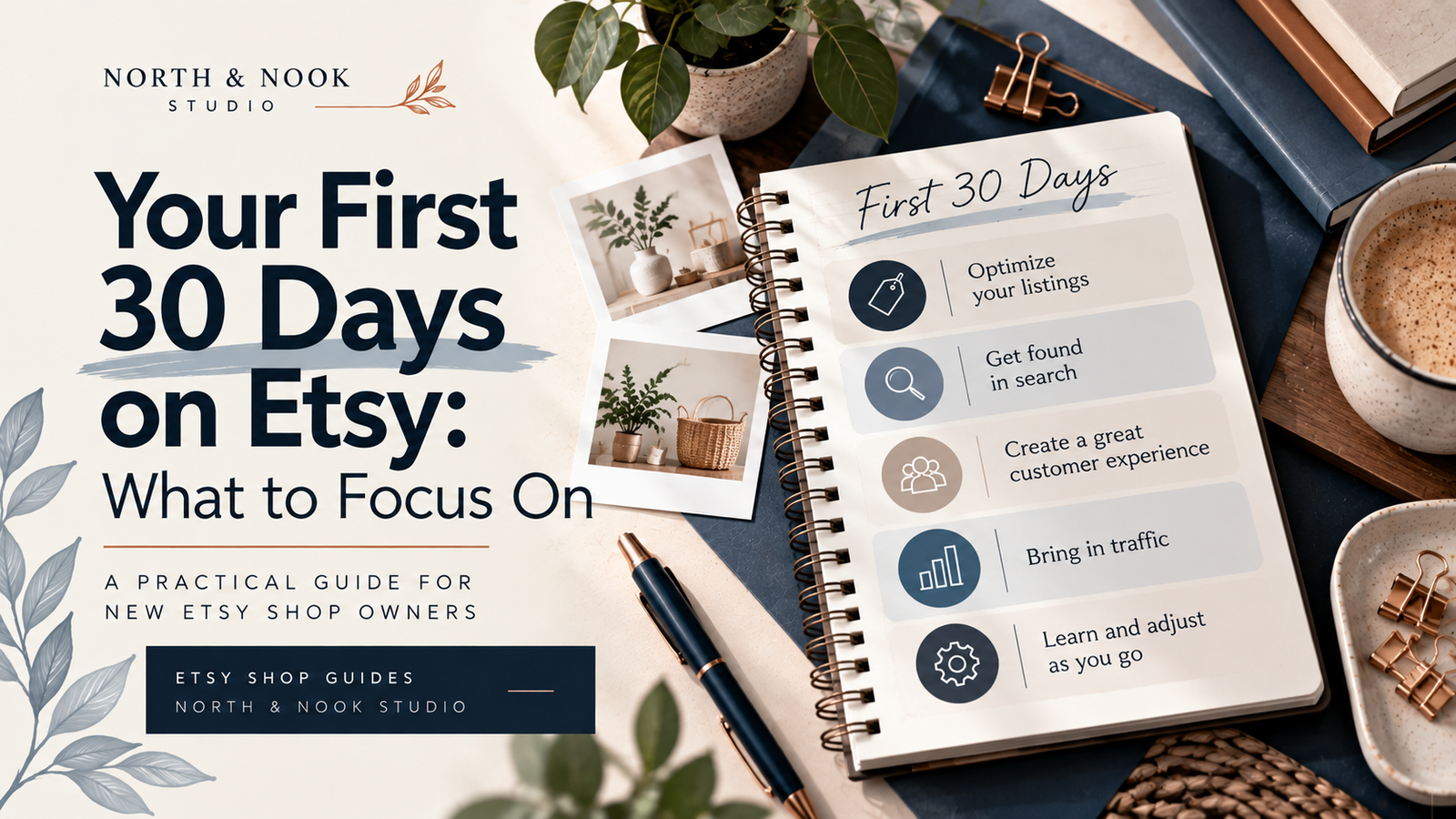
Opening your Etsy shop can feel like the finish line. In reality, it is the beginning of a much more useful stage: learning how real shoppers respond to what you have built.
Your first 30 days on Etsy do not need to be a frantic month of changing everything, adding products every day or checking your shop every few minutes.
They are an opportunity to watch, learn and make thoughtful improvements.
If your shop has only just opened, your goal is not to prove in 30 days that the business will succeed. Your goal is to begin gathering enough real information to make better decisions about your listings, search visibility, customer experience and traffic.
Start with realistic expectations for your first 30 days on Etsy.
A new Etsy shop begins without much shop-specific history. That means the first few weeks can be uneven. One listing may receive attention while another barely gets viewed. Traffic can arrive from different sources, and a quiet day does not necessarily tell you anything meaningful about the long-term potential of your shop.
Try not to turn every visit, favourite or quiet stretch into a verdict.
Instead, use the first month to answer better questions:
If you’re still preparing to open rather than already live, start with our Etsy Shop Launch Checklist so the essentials are in place before you begin evaluating performance.
Your first month is not a pass-or-fail test. Treat it as the beginning of a feedback loop: publish, observe, learn, improve.
Improve the listings shoppers actually see.
Once your shop is live, look at your listings as a shopper would.
Does the first photo make the product immediately understandable? Is the title clear? Have you chosen an accurate and specific category? Does the description answer the questions someone is likely to have before purchasing? Are relevant attributes completed? Are your shop policies clear?
You do not need to rewrite every listing simply because a few days have passed. Instead, look for obvious weaknesses and make purposeful improvements.
Prioritise changes that make a listing clearer, more accurate or more useful to a potential buyer rather than changing things simply for the sake of activity.
Use Etsy’s own data to learn how shoppers are finding you.
It is tempting to type your own keywords into Etsy repeatedly and look for your products in the results. That is not a reliable way to judge your visibility because Etsy search results can vary between shoppers.
Your Shop Stats are more useful. They can show where visits came from, which listings attracted attention and, when available, which Etsy search terms brought shoppers to your listings.
Look for patterns rather than obsessing over individual numbers.
If a listing receives little attention, examine its relevance and presentation. If another attracts more visits, study what may be helping: the product itself, its imagery, the language used to describe it, its keywords or the traffic source.
Search optimisation is not just about squeezing more keywords into a title. Etsy’s current search guidance considers information across titles, tags, descriptions, categories and attributes when matching listings with shopper queries.
Early data is more useful when it leads to a specific question. “Why did this listing get more visits?” gives you something to investigate. “Why isn’t my whole shop working yet?” usually doesn’t.
Build good customer habits before you’re busy.
Your first month is also the right time to establish how you will handle the customer side of your shop.
Respond to buyer messages promptly. Make sure processing expectations are accurate. If you sell physical products, build a reliable fulfilment routine and ship according to the commitments in your listings. Keep your policies and product information clear.
These habits matter beyond making a good first impression. Etsy currently includes customer-service quality among the factors used in search, including measures related to message responses, shipping and tracking where applicable, reviews and cases.
A quiet new shop is actually a useful time to create these routines. It is much easier to establish a workable process before orders become more frequent than to invent one while trying to fulfil them.
Give people more than one way to discover your shop.
Etsy has its own marketplace traffic, but you do not have to sit back and wait for Etsy search to do all of the work.
Choose one or two realistic ways to introduce relevant people to your products outside the marketplace. Depending on your business and audience, that might include Pinterest, social media, an existing email audience, your website or another channel you already use.
You do not need to be everywhere.
One consistently used channel is more manageable than opening five accounts and feeling responsible for feeding all of them.
When reviewing Etsy Stats, you can also see traffic-source information. Over time, that can help you understand whether visitors are arriving through Etsy itself or through the work you are doing elsewhere.
At day 30, review before you react.
At the end of your first month, resist the urge to judge the shop using only one number—especially sales.
Instead, conduct a simple review.
Then choose a small number of priorities for days 31–60.
You might improve several underperforming listing photos. You might refine keywords on listings that are not attracting relevant search traffic. You might add products that logically expand a promising part of your range. Or you might strengthen the outside traffic source that has begun sending interested visitors.
The important part is that your next move comes from something you observed—not from panic.
What not to spend your first month doing.
New-shop energy can easily turn into constant tinkering. More activity does not automatically mean better progress.
If you’re still questioning the underlying offer rather than simply its early performance, our guide to whether your Etsy shop idea is viable can help you separate product questions from normal new-shop uncertainty.
And if something feels off in the way the shop was launched, review the common Etsy shop launch mistakes before assuming the solution is to start over.
Want a more complete Etsy launch system?
The Etsy Shop Launch Lab is North & Nook Studio’s step-by-step digital system for planning, building, launching and improving an Etsy shop—with the course, implementation tools and supporting resources organized in one place.
Explore the Etsy Shop Launch Lab →Learn before you overhaul.
Your early shop data does not need to provide every answer. It only needs to help you make the next decision more thoughtfully.
Your first 30 days are the beginning—not the verdict.
Get your shop in front of real shoppers. Pay attention to what they respond to. Keep the customer experience strong. Use the information Etsy gives you. Then make deliberate improvements one step at a time.
You are not trying to perfect the shop in 30 days. You are building the information and habits that can help you run it better in the months that follow.
Browse Free Resources →